May God bless and keep you always. 愿神灵保佑你 May your wishes all come true. 愿你的美梦都能成真 May you always do for others 愿你无私助人 And let others do for you. 也接受他人馈赠 May you build a ladder to the stars 愿你筑梯摘星 And climb on every rung 步步拾级 And may you stay 愿你 Forever young. 永远年轻 May you grow up to be rightous. 愿你长成正直之人 May you grow up to be true. 愿你保持真诚 May you always know the truth 愿你世事洞彻 And see the light surrounding you. 亦不摒弃光明 May you always be courageous, 愿你勇往直前 Stand upright, and be strong 昂首挺立不惧风险 And may you stay 愿你 Forever young. 永远年轻 Forever young. 永远年轻 Forever young. 永远年轻 May you stay 愿你 Forever young. 永远年轻
May your hands always be busy. 愿你的双手永远充实 May your feet always be swift. 愿你的步伐永远轻快 May you have a strong foundation 愿你踏实坚强 When the winter changes shift. 即使世事无常 May your heart always be joyful. 愿你的心中欢乐满溢 May your song always be sung 你的歌谣能永远唱响 And may you stay 愿你 Forever young. 永远年轻 Forever young. 永远年轻 Forever young. 永远年轻 May you stay 愿你 Forever young. 永远年轻
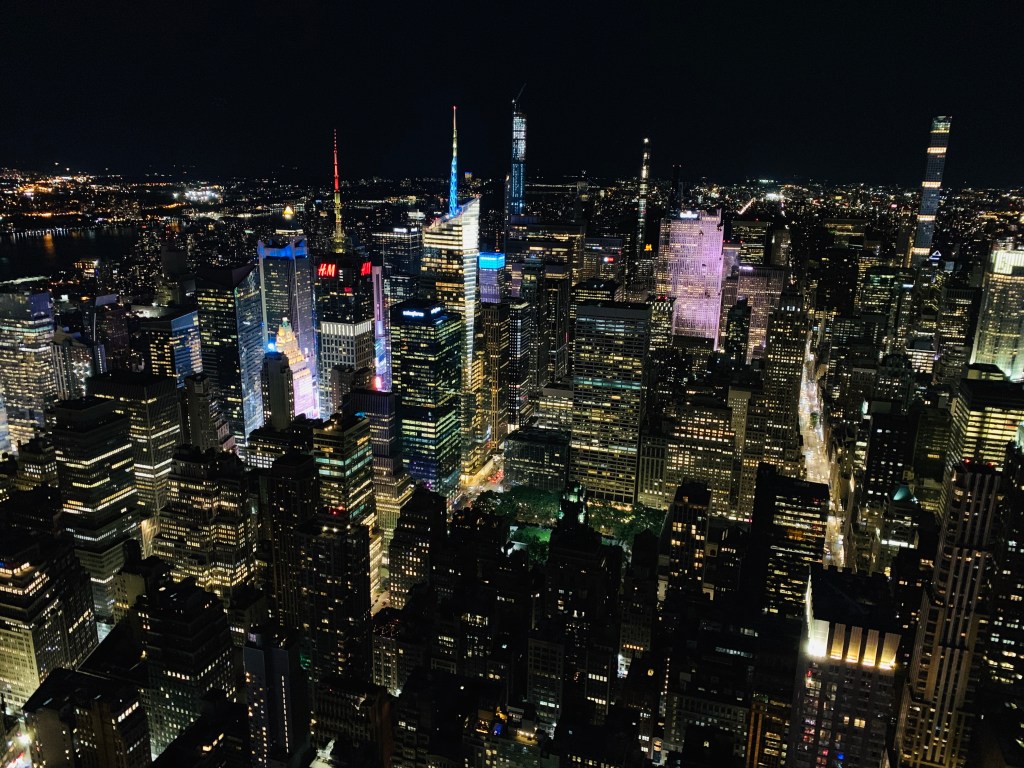
From the Empire State Building, New York. Credit: Fan Zhou
The other day I was initiating the Charles Darwin’s On the Origin of Species by Means of Natural Selection, or the Preservation of Favoured Races in the Struggle for Life(物种起源) based on my supervisor Fuchou Tang’s recommendation. A absolute must read although the conclusions from it seems obvious and true in modern knowledge. You will be shocked by the views in the book only base on the large number observations of species, geography oversea. His logic was so clear that he could make absolutely definitive conclusions without any genetic knowledge at that early stages.
It means, a systematic and acurate description absolutely can provide prospective and new knowledge.
We firstly explored a new marker to enrich the so rare functional HSCs (10-20 cells per embryo) by the unique single-cell initiated in vivo transplant system.
We combined the single-cell transcriptome profiling to uncover the gene expression patterns. The endothelial-to-HSC transition(EC-HSC transition) enriched multiple signaling pathway.
We hypothesis the mTOR could potentially regulate the HSC emergence.
We specifically inhibited the mTOR in the endothelial cells before the HSC formation, resulting in a deletion of HSC emergence.
This looped study strongly indicates the single-cell gene expression patterns (so-called descriptive sequencing-based results) largely helped us mine so much critical potential candidate regulators during this EC-HSC transition. This story and my experience told us these resources could powerful to uncover the principles of many biological process if it is based on,
a. Whether we provided a higher-sensitivity/precision or untouched-yield database by a newly-developed wet/dry strategies, compared with the previous studies. b. Whether we launched inspiring hypothesis based on the data mining (otherwise it maybe just visualize the well-known conclusions in an omics ways). c. Whether we initiate the study with specific questions. d. Whether we link the omics-based conclusion with the phenotype by following functional validations.
The single-cell biology indeed presents a unprecedented opportunity to explore the cell heterogeneity (accurate molecular landscape of the specific cell types) from the multidimensional molecular patterns at a so-far limiting resolution. The deep meaning could be that we can harvest a clear molecule activity map with THE TARGET CELL, which will never been read out with the measurement from bulk cells since it always only contains a AVERAGE level within the mixture of target and untarget cells. Taking the HSC emergence for example, we would never know any new clues from a bulk profiling of the whole AGM tissue (the core site of HSC derivation) or even CD31+CD45+/- cells (containing just one functional HSC from the other fifty cells) of the embryo at the very beginning of our study.
Taking the training from both the conventional developmental biology and single-cell biology together: Besides technically, the higher throughout, more accurate, more applicable in other fields (e.g. industry and clinical diagnosis), simultaneously more multi-dimensional omics methods at single-cell level and less costly, I assumed there will be no widespread question that the near future is absolutely the world of data mining and molecular feature-phenotype linking (a must read from J. Gray Camp et al.). I’m recently thinking about this by myself (you probably heard a lot from others),
Measure/describe the scientific phenomenon/principle.
Explore/understand the deep mechanism behind the principle.
Manipulate the principle to promote the public health and nature.
These probably could be the three major steps and outcomes of life science. Are you enjoyable with your current queue?
The Huashenmiao(the god of flowers) Temple at Peking University, DEC 2019. Credit: Fan Zhou
I have joined a lot of journal club(JC) in my post and current labs. Thinking about the immature experience of JC presentations during my PhD and the latest ones I’ve attended, I got some notes (I’m still learning):
Make it clear that the speakers take both responsibility and opportunity: Make the time worth for the dozens of audiences, meaning you must digest the major information of the aimed papers first. Otherwise you’re probably wasting time (especially others’ time, 20 audiences*30min=600min).
You definitely have these benefits:
Present your own perspectives based on your digesting.
Harvest helpful discussion and feedbacks.
Practice your speech in public.
Common problems/suggestions:
Choose your favorite papers (you will be much more self-motivated with the preparations and passionate about your speeches).
Raise your voice and be passionate.
Modernize your own understanding of the detailed and critical investigation logic.
Outline the valuable information that our own projects may refer.
Discuss the potential drawbacks and future challenges.
Setup the equipment you may need (computer, projector/screen, pointer, microphone, etc. It sounds a regular procedure yet it happens from time to time).
Try more research about unsolved questions during the JC and discuss them with the questioner(s).
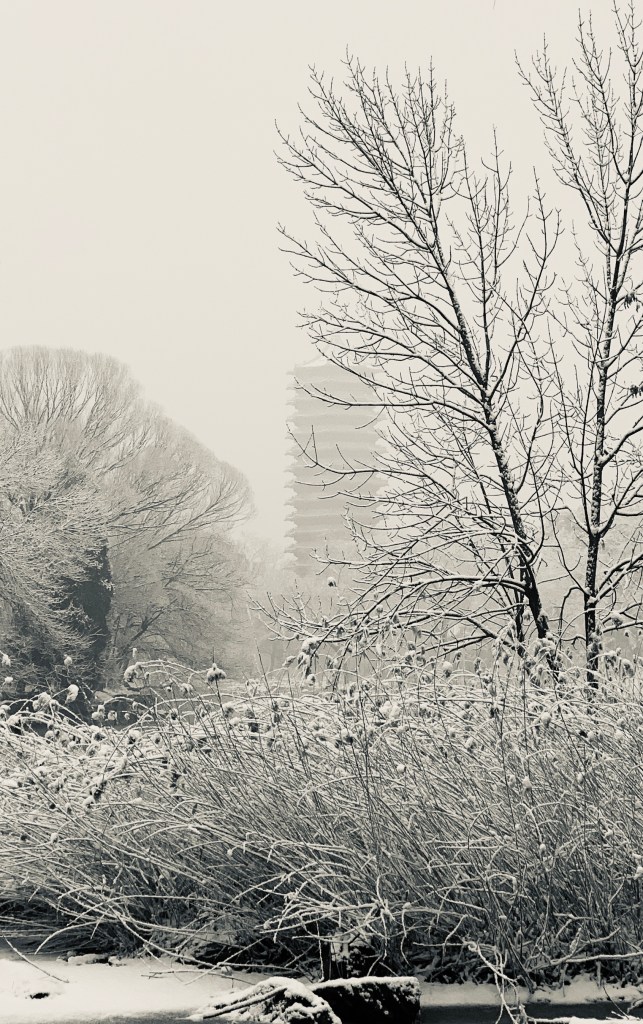
Snow at Peking University, DEC 2019. Credit: Fan Zhou
I’ve been asked a lot about how to write your scientific stories approximately in a non-native language, English. Almost half a year ago, I joined a lecture by Steve Mao, senior editor in Science at Peking University and I think it was absolutely inspiring. I can’t agree with him more about the philosophy:
It’s not the language but the deep logic of your research.
Make your result simple. Do not describe the technical details too much if it’s not that newly-developed.
Outline the major steps or novelties. Order them by the logic (maybe not your original order of experimental progress).
Each paragraph tells just one idea. And mind the logic of inter-sentences inside the paragraph.
If the English became a hinder in ordering your continuous writing process, switch it into your native language. Especially when you outline the logic of the whole story at the very first writing period.
Tell some one who is not your peers about your story, making them clearly understand the major conclusions and the logic behind. This could be so useful until you try it!
The output of this could be that you can tell your whole story within just 20 sentences, 10 sentences (this could be your abstract or part of the cover letter), 5 sentences or even only 1 sentence (this could be the title of your story).
This probably suggests your manuscript is generally ready. By the way, you will never hesitate to so-called largely decrease the length of your pre-accepted manuscript by the editors since you could just easily keep the stem and cut the branches according to the clear logic route.
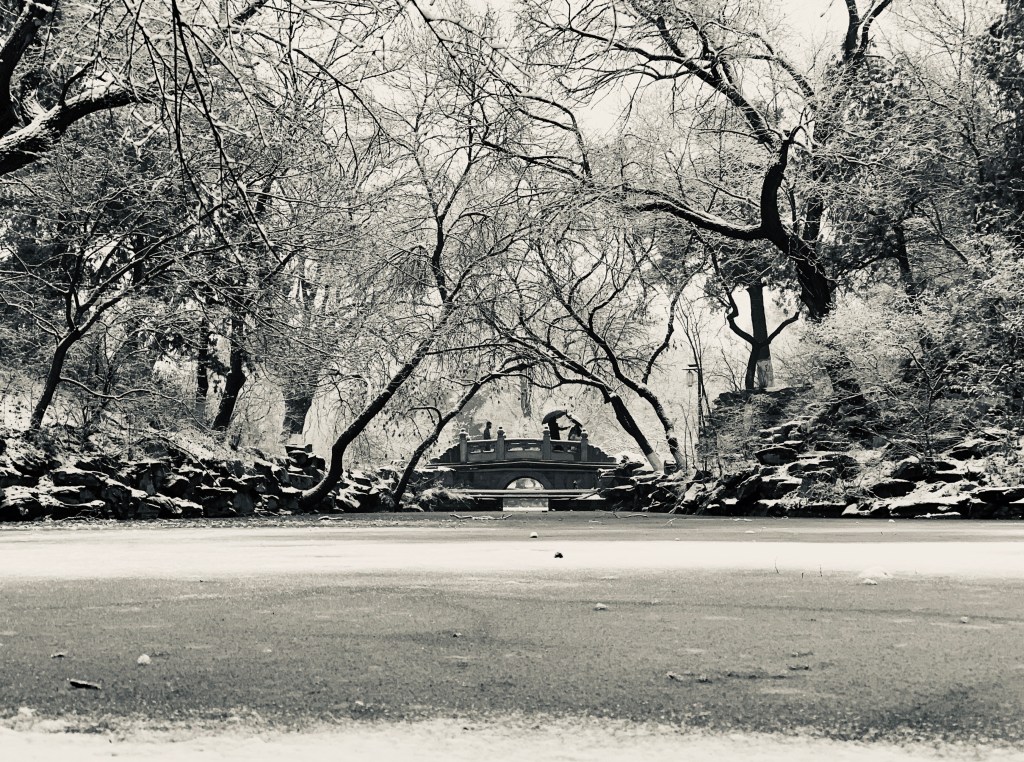
The Weiminghu Lake at Peking University, DEC 2019. Credit: Fan Zhou
During my high school around 2000, besides a one-day break, we celebrated the coming new year (元旦) by the calligraphy competition, the new-year parties, maybe drinking secretly, etc. Like probably everyone else, I sometimes felt depressed under the long-term cramming class and endless examinations. That made the sequential college time evolute into an entirely opposite direction, one of the output could be that we celebrated almost any festivals from inside/outside the nation. The Christmas Day exactly took us a hilarious plus super happy memories. Normally we prepared gifts for the friends, always with a apple (by pronunciation with 苹=平安). All the roommates climbed across the wall of school gate for a whole-night web bar, to play noisy video games, chat with online target girls, watch regular or non-regular movies (do not even ask me what kind of movies, we all were young once), etc. In the near Christmas days I normally sent wishes to my families, friends and be-loved ones, in the hope of their long lasting health and happiness. Apparently the parents around would prepare carefully chosen gifts and spending the time with the kids, making this a big day for them. Indeed, although some of us even don’t know the detailed derivation of this festival, this exact day did creat an unique opportunity to show warm wishes and love to each other. To this meaning, do we really need boycott the festivals from outside like Christmas? In the name of supporting our native and traditional ones? Maybe what we really should do is promoting the fundamental education about our historical culture and conventional special festivals, encouraging more public break in legal with payments…

 Fan Zhou's Blog Site
You must be logged in to post a comment.