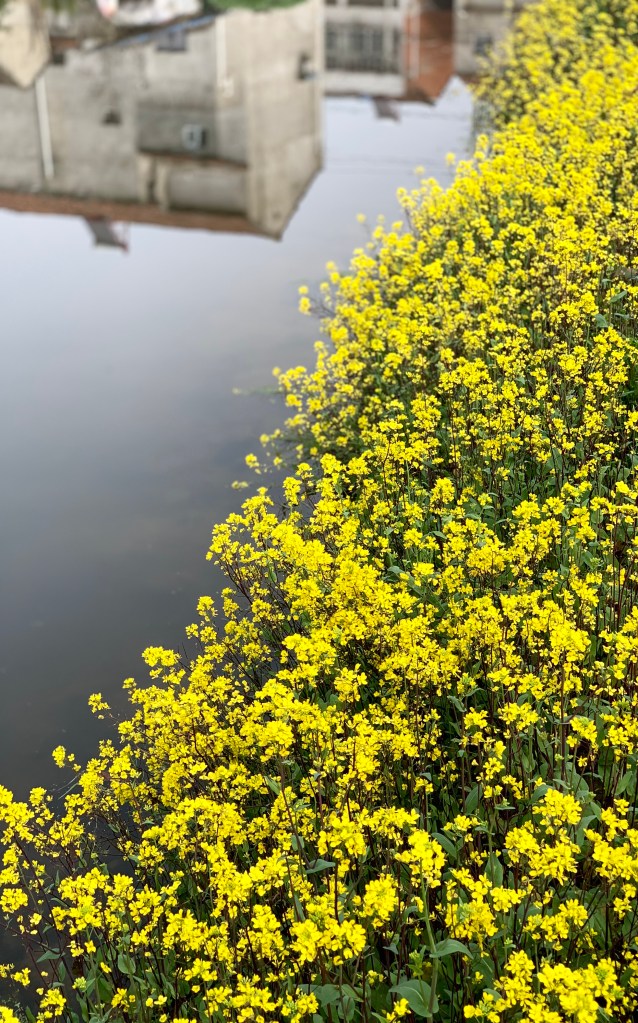
The spring along the country road. Credit: Fan Zhou.
The whole world is not peaceful with the COVID-19 pandemic around more than 100 countries.
I has been blocked at home for nearly two months since the COVID-19 outbreaks. I have to schedule my work at home although I was never a work-from-home guy before. Mostly I think that the home is too comfortable to work in with high efficiency, plus the freezing winter without any heat-system in south of China. After trying so badly for long, I’m still struggling with efficiency and time coordination. But I do have some progress and tips so far.
Basically, you got three major troubles: wild cold/warm bed, TV and cell phone.
Set a daily and feasible mission list.
Never settle yourself near the bed. Don’t even think about it about “maybe I can work in bed actually only because the warm bedding “.
Manage your time accurately, including the time for meal, sleep, TV, nap, bath, and work.
Teeth-brushing always wake you up entirely from the early morning.
Stay away from your cell phone.
Wear regular shoes, not slippers.
Participate in or organize online meetings.
A lot of people would say that they wished the 2020 could been restarted. Sadly, we all know that it will never happen.
Just finished my first lecture qualification, entitled ‘Cell fate and single-cell analysis’, in COVID-19 epidemic area with Zoom. I got some suggestions from the kind and senior teachers, the inspection officers at THU. I wrote them down to make some memories and remind myself all the time. Due to the isolation and the block with the COVID-19, I used the slide-show instead of any possible formats even though I really would like to challenge some chalk class in the first place.
I would rather apply the science images and videos instead of large range of words in the slides. This could be nice and vivid for the audience and students except one situation, the specific biological conceptions, e.g. the Developmental Biology, Cell Fate, Single-cell Omics, et al. Besides, you’d better label the critical words both in English and Chinese.
Personally, I prefer a dark (mostly black) background in my slides since I think this could be helpful for attracting the audiences’ attention since years ago. Generally, this means that I have to take extra time to transit a lot of original images from publications into the dark background pages by Photoshop, enabling that they will match the main color of my slides, black. Unfortunately, I didn’t do it for all the images somehow because I didn’t spend enough time to ensure these details. And I was pointed out about half dark and half light in my slides, causing kinda of visual dissonance, which is not good thing for the audience. So I’m gonna correct it next time.
Manage the rhythm of my speaking. Like some other new guys, I sometimes talk too fast. One way is that I did use a timer along my talk. And a useful suggestion is that I could ask some short questions to the audience and wait several seconds or even minutes, ensuring that they really digest and understand what I have talked before.
Can’t wait for more practice and hope that I will make some progress.
Hi, everyone. I’m delighted to announce that the Zhou Lab at Tsinghua is about to launch.
We aim to understand the principle and regulatory mechanisms of cell fate decision/transition during embryonic development and disease evolution, with new technologies of single-cell in vivo and in vitro functional identification, single-cell omics analysis and genetics strategies.
Our work mainly includes the following three directions:
Apply and develop new single-cell multi-omics analysis to analyze the molecular expression patterns of lineage specialization during embryonic development;
Develop in vivo and in vitro models to understand the regulatory mechanism of cell fate transition during embryonic development at the phenotypic/functional dimension;
Explore the regulatory circuit during the embryo implantation and the evolution of reproductive tumors.
Motivated postdocs with expertise in biochemistry, molecular biology, cell biology, mouse physiology, bioinformatics or biostatistics are encouraged to apply. Please email a cover letter, your CV, and contact information for three references to zhoufanlove(AT)126.com.
The enthusiastic and down-to-earth PhD students/undergraduate interns, who are interested in joining our lab, are also welcome to contact zhoufanlove(AT)126.com directly. Please send a pdf CV.
We read every email.
Come and do some lovely research. Your place at Tsinghua yard is already reserved.
About Fan Zhou
Fan received his PhD training in hematopoietic stem cell (HSC) development at Dr. Bing Liu’s lab, Academy of Military Medical Sciences. With a developed single-cell-initiated in vivo serial transplantation system, he explored that multiple signalling pathways and transcription factor networks played critical roles during HSC emergence (Li et al., JGG, 2013, Zhou et al., Nature, 2016). Fan subsequently joined Dr. Fuchou Tang’s group at Peking University as a postdoc to study molecular regulating early human embryogenesis. Combining an in vitro simulation of implantation strategy and single-cell omics, Fan reconstituted the gene networks and DNA methylome patterns of human implantation, revealing that lineage-specific gene-expression networks in coordination with epigenetic factors (e.g. DNA methylation) might simultaneously regulate cell fate determination during implantation (Zhou et al., Nature, 2019). Fan has received a number of awards on understanding cell fate transition during embryogenesis, including the Ray Wu Prize from Ray Wu Memorial Fund (2016) and Young Elite Scientists Sponsorship Program from China Association for Science and Technology (2017). Fan will join the faculty and become a principal investigator (PI) at School of Life Sciences/Center for Life Sciences, Tsinghua University. The Zhou Lab will focus on cell fate decision during mammalian/human embryo development with single-cell in vitro/vivo functional and omics analysis.


 Fan Zhou's Blog Site
You must be logged in to post a comment.